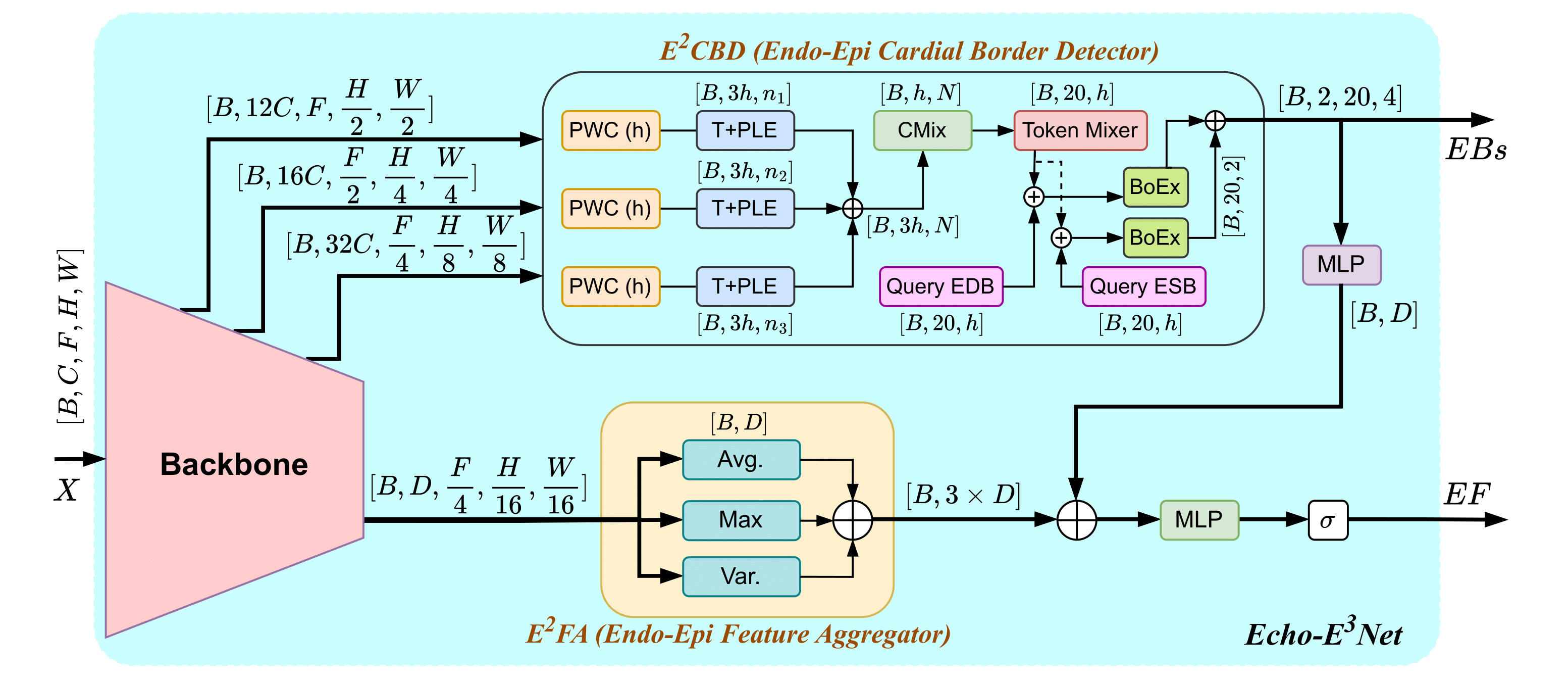
Left ventricular ejection fraction (LVEF) is a primary marker of cardiac function. However, routine estimation from endocardial measurements requires manual delineation at end-diastole (ED) and end-systole (ES), a process that is time-consuming and subject to inter-observer variability. Reliable automation is especially valuable for point-of-care ultrasound (POCUS), where computational resources are limited and acquisition quality varies. We propose Echo-E³Net, an anatomy-guided spatio-temporal network that explicitly embeds cardiac anatomy into LVEF prediction. A dual-phase Endocardial Border Detector (E²CBD) uses phase-specific cross-attention to localize ED/ES endocardial landmarks and produce phase-aware landmark embeddings, while an Endocardial Feature Aggregator (E²FA) fuses these embeddings with global statistical descriptors of deep feature maps to refine EF regression. Training is guided by a lightweight geometric loss that uses ED and ES endocardial landmarks to regularize EF prediction. On EchoNet-Dynamic and a PSAX subset of EchoNet-Pediatric, Echo-E³Net attains competitive performance using only 1.55M parameters and 8.05 GFLOPs, an order-of-magnitude compute reduction versus recent baselines, supporting real-time deployment. Our code is publicly available at https://github.com/moeinheidari7829/Echo-E3Net.
@article{heidari2025echoenet,
  title   = {Echo-E$^3$Net: Efficient Endocardial Spatio-Temporal Network for Ejection Fraction Estimation},
  author  = {Heidari, Moein and Bozorgpour, Afshin and Zarif-Fakharnia, AmirHossein and Chen, Wenjin and Merhof, Dorit and Foran, David J. and Grewal, Jasmine and Hacihaliloglu, Ilker},
  journal = {arXiv preprint arXiv:2503.17543},
  year    = {2025}
}